


Table of Contents
- High Quality vs Cheap Wall Art: The Real Differences
- What Makes Wall Art Look Expensive?
- Art Print Paper Quality: The Foundation of Longevity
- Canvas vs Paper Art Prints: Which Suits Your Space?
- Professional Art Print Framing: What to Expect
- How to Assess Quality Before You Buy Online
- Total Cost of Ownership: Cheap vs High-Quality Wall Art
- Frequently Asked Questions
Last Updated: October 19, 2026
High Quality vs Cheap Wall Art: The Real Differences
Walk into a room with a well-framed print and you notice it before anything else. The opposite is also true: cheap wall art announces itself the moment you step closer, with rippled paper, washed-out colour and a frame that never quite sits flat.
The short answer: cheap wall art saves money at checkout, while high-quality wall art saves money across the years it hangs on your wall. That gap comes down to four things: paper, printing, framing and how carefully the piece was made.
The Getty Conservation Institute's guidance on light and fading in works on paper explains why inks and papers age at different rates. That science matters here, because it is the difference between art that looks the same in five years and art that has quietly turned yellow.
What Makes Wall Art Look Expensive?
Expensive-looking wall art comes down to contrast, texture and finish, not the price tag. A piece reads as premium when the blacks are deep, the paper has visible weight, and the frame sits tight and square against the wall. Those three signals do more work than any brand name.
Here is what actually creates that impression:
- Deep, even blacks. Cheap printing often produces greyish blacks because the ink layer is thin.
- Visible paper texture. Matte, cotton-style papers catch light softly. Thin glossy paper reflects it harshly.
- A frame that sits flush. Gaps at the corners and a wobbling profile undo everything else.
- Consistent margins. Even white space around the print signals care and intention.
The reverse is just as easy to spot. A print that arrived rolled in a tube, then flattened badly, will always show a slight wave. A frame with visible staples or a plastic-looking finish pulls the whole room down with it. In practice, most people blame the artwork when the real problem is the framing and the paper underneath it.
Art Print Paper Quality: The Foundation of Longevity
Art print paper quality is the single biggest predictor of how a print will look in five years. Paper weight, finish and acidity determine whether colours stay true or drift, and whether the sheet stays flat or cockles over time.
Here is what the numbers on a product page actually mean:
- Weight (gsm). Paper is measured in grams per square metre. Standard office paper sits around 80-90 gsm. Most poster and budget art prints fall in the 150-200 gsm range, which feels thin and tends to wave. Fine art and photographic prints commonly start around 200 gsm and run to 300 gsm or more, which feels substantial and resists curling.
- Acidity and buffering. Acidic paper breaks down from within, turning brittle and yellow. Look for the words acid-free or archival, and ideally a pH-neutral or buffered stock. A seller who cannot state this is a seller who has not specified it.
- Finish. Matte scatters light and keeps colours readable from any angle. Gloss reflects and can look harsh under ceiling lights. Satin and textured stocks sit between the two and hide fingerprints better than gloss.
- Ink type. Pigment-based inks sit on the paper surface and resist fading far better than dye-based inks, which soak in and fade faster. If a listing says only 'high-quality inks', ask which type.
Our own prints use museum-quality matte paper sourced from Japan, and that choice is deliberate. Heavier matte stock holds ink without pooling, resists curling, and gives the finished piece a soft, gallery-like surface.
The Getty Conservation Institute's guidance on light and fading in works on paper explains why inks and papers age at different rates. The short version: light exposure and paper chemistry together decide whether a print looks the same in five years or has quietly turned yellow.
Canvas vs Paper Art Prints: Which Suits Your Space?
Canvas prints suit large, casual spaces where texture and warmth matter more than fine detail. Paper prints suit sharper, more precise work, especially minimalist and graphic designs, and they frame more cleanly.
| Factor | Canvas Prints | Paper Prints |
|---|---|---|
| Texture | Woven, visible grain | Smooth or softly matte |
| Detail | Softer edges | Crisp, fine lines |
| Framing | Usually stretched, often unframed | Requires a frame for best results |
| Best for | Living rooms, large walls | Minimalist decor, gallery walls, offices |
| Care | Dust-prone, harder to clean | Easy to dust behind glass |
Canvas has one real advantage: it needs no frame, so the upfront cost looks lower. That advantage fades when you want a refined, gallery-style look, because canvas edges rarely sit as cleanly as a framed paper print. Paper gives you control over the frame finish, the mat and the final size, which is why most minimalist interiors lean toward framed prints.
Professional Art Print Framing: What to Expect
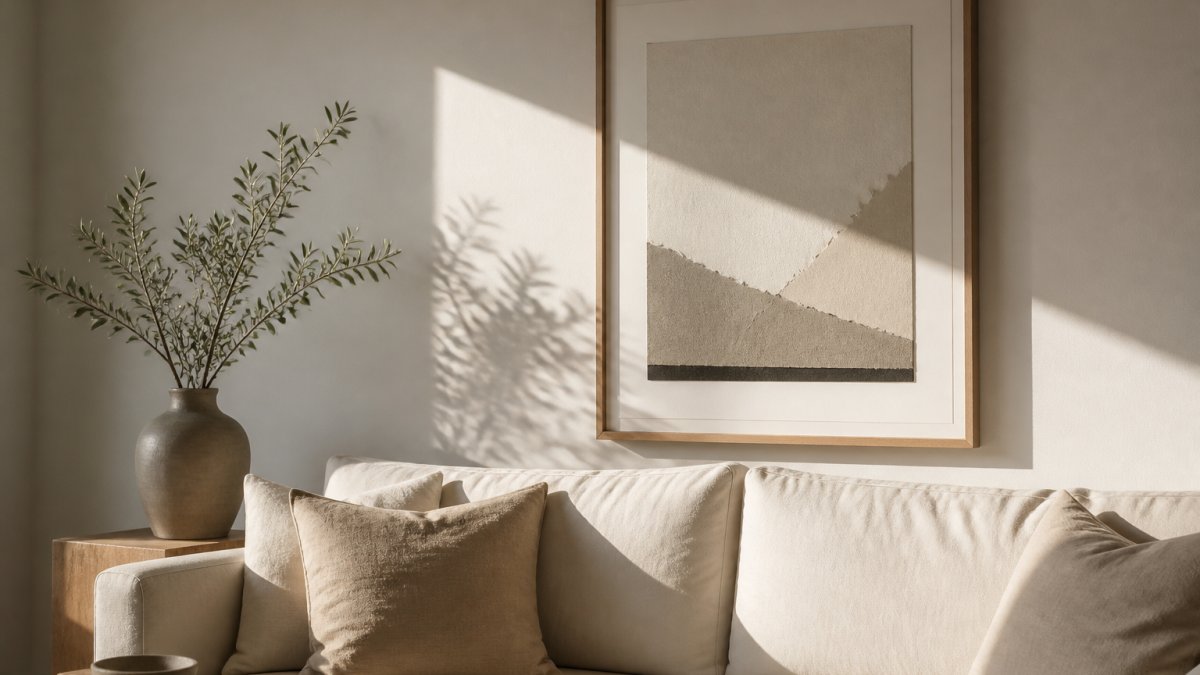
Professional art print framing means the print is mounted square, protected behind glazing, and finished with a backing that keeps dust and moisture out. Done properly, the print sits flat, the corners meet cleanly, and the piece arrives ready to hang.
What separates professional framing from a budget job:
- Square mounting. The print is aligned to the frame, not trimmed to fit.
- Clean corner joints. Mitred corners should meet with no gap or overlap.
- Proper backing. A rigid backing board stops the print from bowing.
- Hanging hardware included. A framed piece should not need a trip to the hardware shop.
A common mistake is buying a cheap frame and a good print, then wondering why the result looks flat. The frame is not a neutral container. It sets the margin, controls glare and determines whether the piece feels considered or thrown together. If you already own unframed prints, ask the seller whether frames are sold separately before you assume you have to start over.
How to Assess Quality Before You Buy Online
You cannot touch a print through a screen, so you have to read the listing like an inspector. The signals are all there if you know which lines to check.
Use this checklist before you add anything to a cart:
- Does the listing name the paper weight and confirm it is acid-free?
- Are the inks described as pigment-based rather than dye-based?
- Is the frame material stated, or is it just called "wood-effect"?
- Are exact dimensions given for both the print and the outer frame?
- Is there a photo of the piece in a real room, not just a flat mockup?
- Does the seller show the back of the frame or the hanging hardware?
- Is there a clear returns policy for damage in transit?
- Do reviews mention colour accuracy and how the piece looked in person?
Two of these carry more weight than the rest. Colour accuracy is the most common complaint in online art shopping, because screens vary and previews are often brightened. A seller who shows the piece in real lighting, and who is upfront about how colours may differ, is usually the safer bet. The second is made-to-order timing. If you need a housewarming gift by a certain date, confirm the production window before you order, not after.
The Federal Trade Commission's guidance on online shopping and refund rights is worth a skim if you are buying a gift and want to understand what you are entitled to if something arrives damaged.
Total Cost of Ownership: Cheap vs High-Quality Wall Art
Total cost of ownership is where the cheap option stops looking cheap. A low-priced print that fades, warps or arrives with a wobbly frame gets replaced, and the second purchase wipes out the saving from the first.
Here is how the two paths usually play out:
| Cost Factor | Cheap Wall Art | High-Quality Wall Art |
|---|---|---|
| Upfront price | Lower | Higher |
| Framing | Often flimsy or sold separately | Included and professionally finished |
| Shipping and returns | Flat-packed, damage-prone, return shipping often on you | Protective packaging, clearer damage policy |
| Lifespan | Fades or warps within a few years | Holds colour and shape for years |
| Replacement | Likely within 2-3 years | Rare |
| Care | Dust-prone, hard to clean behind plastic | Easy to dust behind glass |
| Resale or gifting | Low perceived value | Reads as a considered gift |
| Total over 5 years | Purchase plus one or two replacements | One purchase |
The maths is simple once you frame it this way. Two cheap prints over five years usually cost more than one good one, and the good one looks better the entire time.
There is an environmental angle too. Every replaced print is another sheet, another frame and another delivery. Buying once and keeping it is the lower-waste choice, and it is the reason archival materials matter beyond aesthetics.
Use this decision framework before you buy:
- Budget under a certain threshold and short lifespan acceptable? A budget print is fine for a rental, a seasonal refresh or a child's room.
- Viewing distance close? In a hallway or above a desk, paper texture and print sharpness are visible, so quality matters more.
- Room use high-traffic or humid? Kitchens, bathrooms and hallways punish cheap materials fastest.
- Want to keep it five years or more? Buy archival paper and professional framing once.
That is the case for buying well.
Frequently Asked Questions
How can you tell if a wall art print is good quality?
Look for the paper weight and finish: quality prints use heavier stock, often 200gsm or above, with a matte or textured surface. Check the print method; giclée or archival pigment printing gives sharper detail and better color reproduction than standard offset. Ask about fade resistance and whether the inks are archival. A reputable seller will list these details. Also inspect the frame: solid wood or metal, clean joints, and proper backing. If the listing is vague about materials, assume lower quality.
Does expensive wall art last longer than cheap wall art?
Not automatically, but higher-quality materials typically age better. Cheap prints on thin paper with dye-based inks can fade within a year or two in direct light. Archival pigment inks on acid-free paper can last decades without noticeable fading. Frames matter too: a well-built frame with proper matting protects the print from moisture and handling damage. The key is whether the maker specifies archival materials. Price alone is not a guarantee, but very low prices often mean thinner paper and less durable inks.
Is a canvas print better quality than a paper art print?
They serve different purposes. Canvas prints have a textured surface and come ready to hang without glass, which suits casual or large-format spaces. Paper prints, especially on heavyweight matte stock, offer sharper detail and richer color depth, making them better for fine art reproduction and gallery-style framing. Canvas can sag over time and is harder to clean. Paper prints under glass are easier to preserve. Neither is inherently better; choose based on the look you want and the level of detail in the artwork.
What should I look for in a framed art print?
Check the frame material and construction: solid wood or metal, with tight corners and a rigid backing. Look for acid-free matting or spacers that keep the print off the glass. Glass or acrylic should be clean and ideally UV-filtering. The print itself should be on heavyweight, matte paper with no glare. Ask about the hanging hardware; a quality frame comes with proper D-rings or a wire, not just a sawtooth hanger. Finally, confirm the return policy in case the color differs from your screen.
Cheap wall art is a decision you make again every couple of years. High-quality wall art is a decision you make once. LagomDesigns makes framed minimalist prints to order, professionally framed and ready to hang, in four sizes and three frame finishes, using museum-quality matte paper sourced from Japan. Each piece is designed to work alone or as part of a gallery wall, so you can build a calm, balanced space without starting over. Search our store to find the piece that fits your wall.


