


Table of Contents
- Why Affordable Framed Art Belongs on Your New-Home List
- Quick Comparison: 7 Affordable Framed Wall Art Pieces
- 1. Neutral Shapes: The Best Online Shops for Framed Art Start Here
- 2. Calming Hues: Soft Color for Bedrooms and Quiet Corners
- 3. Homely Lines: Line Art That Warms Hallways and Entryways
- 4. Neutral Abstract: A Safe Bet for Living Rooms and Home Offices
- 5. Neutral Tones: Earthy Minimalism for Japandi and Scandi Rooms
- 6. Soft Minimal Boho: Warmth Without Clutter
- Gallery Wall Ideas for New Homes (Without Making Every Room Identical)
- What Affordable Framed Wall Art Actually Costs
- Frequently Asked Questions
Last Updated: October 21, 2026
Why Affordable Framed Art Belongs on Your New-Home List
Affordable framed art is the fastest way to make a new house feel lived in.
Most new-home guides treat wall art as the final decorative layer. In practice, art should go up early because it sets the palette and mood everything else responds to.
Below: seven calm, budget-friendly picks, plus realistic costs, sizing rules, and rental-friendly hanging advice.
Quick Comparison: 7 Affordable Framed Wall Art Pieces
| Piece | Price | Best Room | Palette |
|---|---|---|---|
| Neutral Shapes | $33.50 | Living room, office | Soft neutral geometric |
| Calming Hues | $33.50 | Bedroom, meditation corner | Subtle blended tones |
| Homely Lines | $33.50 | Hallway, entryway | Delicate line art |
| Neutral Abstract | $33.50 | Living room, home office | Warm neutrals |
| Neutral Tones | $33.50 | Japandi and Scandi rooms | Earthy minimal |
| Soft Minimal Boho | $33.50 | Bedroom, creative studio | Warm organic shapes |
| Meadow | $50.00 | Nursery, quiet corner | Peach, coral, sage |
Every piece is professionally framed, arrives ready to hang, and ships with hardware included, a detail that matters when you are hanging art in five rooms.

1. Neutral Shapes: The Best Online Shops for Framed Art Start Here
If you are comparing the best online shops for framed art, start with the piece that works in the most rooms. Neutral Shapes pairs abstract geometric forms with calming neutral tones, so it slides into a living room, bedroom, or home office.
The frame is 1.9 cm Ayous wood from renewable forests, with 189 g/m² matte paper behind an Acrylite front protector and hardware in the box.
2. Calming Hues: Soft Color for Bedrooms and Quiet Corners
Bedrooms are where budget art usually goes wrong: people buy something dramatic, then wonder why the room never feels restful. Calming Hues uses subtle tones and a clean abstract composition to lower the visual temperature.

Hang it beside a bed or above a reading chair, at eye level when seated. It also suits meditation corners, where a soft palette does more than a statement print.
Same build as the range: 1.9 cm Ayous wood frame, 189 g/m² matte paper, Acrylite glazing, hardware included. At $33.50, it is one of the cheapest ways to change how a bedroom feels.
3. Homely Lines: Line Art That Warms Hallways and Entryways
Entryways get ignored in most new homes, which is a mistake, it is the first wall a guest sees and the last one you walk past at night. Homely Lines adds warmth to narrow spaces without crowding them.

A common mistake is hanging entryway art too high. Aim for the center of the print around 145 cm from the floor, roughly eye level for most adults, and keep it narrower than the wall section between doors.
Pair it with a slim console or a single hook for keys, the art does the decorating.
4. Neutral Abstract: A Safe Bet for Living Rooms and Home Offices
Living rooms and home offices ask different things of art: one needs to feel welcoming, the other needs to stay out of the way on video calls. Neutral Abstract handles both.
For home offices, hang the print behind the camera, not behind your monitor, a calm, uncluttered background reads as professional on calls.
5. Neutral Tones: Earthy Minimalism for Japandi and Scandi Rooms
Japandi and Scandinavian interiors live or die on restraint, and Neutral Tones was built for that brief.
Choose it for a room with warm wood tones: the palette picks up natural materials instead of competing with them.
A note on quality at this price: before buying any budget frame, check for a frame thickness in millimeters or centimeters, a paper weight in g/m², and a named glazing material.
6. Soft Minimal Boho: Warmth Without Clutter
Bohemian styling has a reputation for clutter, often deserved. Soft Minimal Boho keeps the warmth and drops the noise with soft tones and gentle organic shapes.
It suits bedrooms, creative studios, and meditation spaces, and pairs easily with plants and textiles. If you own rattan or jute, start here.
Gallery Wall Ideas for New Homes (Without Making Every Room Identical)
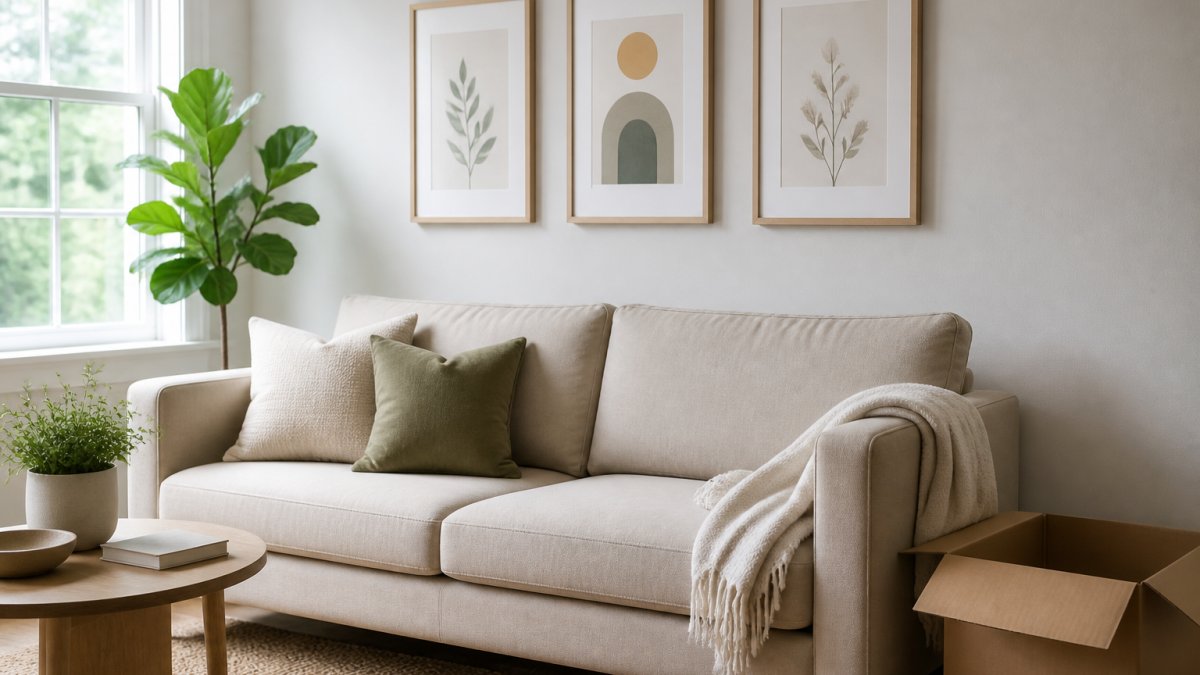
Most gallery wall guides show a pretty grid and stop there, not helpful when you have five empty rooms. Here is a room-by-room starter plan, a framework for a cohesive collection, and installation advice that protects your walls and frames.
A room-by-room starter plan for a new home
Prioritize art by where you and your guests spend the most time and which walls are most visible. A practical sequence:
- Living room first. Start with one large piece above the sofa, centered on the furniture rather than the wall. If you plan a gallery wall, build it here first to establish the frame finish and palette that will repeat through the home.
- Entryway second. One narrow vertical piece or a small row of three works well. Keep the center of the art around 145 cm from the floor, roughly eye level for most adults.
- Bedroom third. Choose softer palettes and hang one medium print above the bed or two smaller prints stacked vertically beside it.
- Home office fourth. If you take video calls, hang a calm, uncluttered print behind your chair, not behind your monitor. A neutral abstract or soft landscape reads as professional on camera.
- Hallway and secondary rooms last. These are lower-stakes walls. Use them to experiment with smaller pieces or to place art that did not fit the palette of the main rooms.
This order stops you from spending your whole art budget on a hallway nobody looks at while the living room stays blank.
How to coordinate a collection without making every room identical
The common mistake is buying matching sets for every room, which makes a home look like a furniture showroom. Repeat one or two elements and vary the rest:
- Repeat the frame finish. Choose one frame color or wood tone, such as natural Ayous wood, and use it across the home. This is the strongest visual thread and the easiest to maintain when you add pieces later.
- Vary the subject and palette by room. The living room can carry a geometric abstract, the bedroom a soft blended print, and the hallway delicate line art. The frame ties them together; the artwork gives each room its own character.
- Vary size and orientation. A large landscape print in the living room, a vertical pair in the bedroom, and a horizontal row in the hallway create rhythm without repetition.
A starter plan that costs less than most single statement pieces:
- Living room: one large landscape print above the sofa, centered on the furniture
- Bedroom: two smaller prints stacked vertically beside the bed
- Hallway: three prints in a row, aligned to the same center line
Keep frames consistent and let the artwork differ, that single rule stops a collection from looking like a showroom set.
Rental-friendly and damage-minimizing installation
New homeowners and renters alike need to hang framed pieces safely. A few practical rules:
- Use the included hardware. Every framed piece in this collection ships with hanging hardware, which removes the guesswork and the extra cost of buying hooks separately.
- For frames wider than 60 cm, use two hooks. Place them about 2.5 cm from each top corner on horizontal frames. A single nail in drywall is the most common cause of dropped frames and patched walls.
- Match the anchor to the wall. Drywall anchors are fine for most frames under 10 kg. For plaster or lath walls, use a stud finder or toggle bolts. If you are renting, removable adhesive hooks rated above the frame's weight are a safer choice for lightweight pieces.
A note on sizing for common walls and furniture
Sizing is where most new homeowners undershoot. A print that looks generous online can look lost above a sofa. Use these proportions:
- Above a sofa: the art should span about two-thirds of the sofa's width. For a 200 cm sofa, aim for a print or gallery arrangement about 130 cm wide.
- Above a bed: aim for the same two-thirds proportion of the bed width. A queen bed is about 150 cm wide, so a print around 100 cm wide works well.
- On an empty wall: keep the bottom edge at least 15 cm above the furniture below it, and center the art at roughly 145 cm from the floor.
These measurements are starting points, not rigid rules. The goal is to avoid art that is too small for the wall and art hung too high.
What Affordable Framed Wall Art Actually Costs
Affordable framed wall art costs more than the sticker price once you add the extras most listings hide. Here is the honest breakdown for a five-piece starter collection.
The all-in cost breakdown
| Cost Item | Typical Range | Notes |
|---|---|---|
| Framed prints | $33.50 to $50.00 each | Prices from our current collection |
| Hanging hardware | Included | Comes with every framed piece |
| Shipping | Varies by order | Check before checkout; some shops charge per-item |
| Extra hooks or anchors | Small add-on | Only if wall type requires it |
| Mats | Not needed | Frames arrive ready to hang |
| Professional hanging | Optional | Most people hang these themselves |
For a five-piece collection using the $33.50 pieces, the art cost is $167.50 before shipping. Add a modest shipping charge and a few dollars for extra anchors if your walls need them, and you are still well under the cost of a single custom-framed print.
Why ready-made frames save so much compared to custom framing
Buying framed instead of unframed plus custom framing is where the savings show up. Custom framing quotes often exceed the cost of the print several times over because you pay for custom-cut moulding, matting, glazing, and labor. Ready-made frames remove that line item entirely.
A custom frame for a mid-sized print often costs more than three or four of our complete framed pieces.
What you get for the price
Every framed piece in this collection includes:
- A 1.9 cm Ayous wood frame sourced from renewable forests
- 189 g/m² matte paper
- Acrylite front protector instead of glass, which is lighter and safer for shipping
Those specs are the difference between art that looks good on day one and art that survives a move or a humid summer. Check frame thickness, paper weight in g/m², and a named glazing material before buying any budget frame, if a shop hides them, the frame is usually the weak point.
Sizing guidance that affects total cost
Sizing and cost are linked: a larger print costs more but often replaces multiple smaller pieces, saving money on frames and hardware.
- Above a sofa: art should span about two-thirds of the sofa's width. For a 200 cm sofa, one large print around 130 cm wide usually looks better and costs less than three small prints that add up to the same width.
- Above a bed: aim for the same two-thirds proportion of the bed width. A queen bed is about 150 cm wide, so a print around 100 cm wide works well.
- On an empty wall: keep the bottom edge at least 15 cm above the furniture below it, and center the art at roughly 145 cm from the floor.
A single generous print almost always looks better than three small ones scattered across the same space. The frame cost barely changes, but the visual impact does.
A realistic budget for a new home
Starting from scratch? Phase the spending:
- Phase 1 (move-in month): one large piece for the living room and one for the entryway. This covers the two most visible walls and sets the frame finish for the rest of the home.
- Phase 2 (first three months): bedroom and home office pieces. These are lower-visibility but high-impact for daily life.
- Phase 3 (first year): hallway and secondary rooms. By this point you know your palette and can add pieces that fit the collection.
Phasing keeps the upfront cost manageable and prevents buying too many small pieces at once, then replacing them when rooms still feel unfinished.
Frequently Asked Questions
Where can I buy affordable framed art online?
Look for a shop that sells the frame and print together, so you are not paying twice for shipping. LagomDesigns is one of the best online shops for framed art if you want minimalist pieces: each print arrives professionally framed in an Ayous wood frame with an Acrylite front protector and hanging hardware included. Prices start at $33.50, and because pieces are made to order, you are not paying for warehouse overstock. Check the paper weight (189 g/m² here) and whether hardware is included before you compare prices elsewhere.
What is the cheapest way to decorate a new home with framed art?
Buy fewer, larger pieces instead of many small ones, and choose framed prints over custom framing. At LagomDesigns, most pieces cost $33.50, with Meadow at $50.00 and the Bauhaus Riso Constellation at $56.25, and every order includes the frame and hanging hardware. That means your total cost is the listed price plus any shipping, with no separate frame or mat bill. Start with one statement piece per main room, then add a second piece once you see how the first sits on the wall.
How do I choose framed art that suits my home?
Match the palette to what is already in the room rather than to a trend. If your furniture is warm wood and cream, choose earthy or neutral tones; if your walls are cool white, soft abstract shapes work well. Consider the room's job too: bedrooms suit calmer pieces such as Calming Hues, while a home office benefits from structure, like Abstract Architecture. Order one piece first, live with it for a week, then build the rest of the wall around it.
What size framed art should I buy for a living room?
A common rule is to fill roughly two-thirds to three-quarters of the width of the furniture below the art. Above a standard sofa, one large horizontal frame or a group of three smaller frames works well. LagomDesigns pieces come in four sizes, and for 24 x 36 inch horizontal frames the mounting hooks go 1 inch (2.5 cm) from each corner. Measure your wall and sofa before ordering, and mark the outline with painter's tape to check the proportion.
How do I arrange framed art on a gallery wall in a rental?
Plan the layout on the floor first, then transfer it to the wall with paper templates and removable adhesive strips before committing to nails. Keep 5 to 8 cm between frames so the group reads as one unit. In a rental, choose lighter pieces: LagomDesigns frames are lightweight with Acrylite glazing instead of glass, which reduces the load on plasterboard. Patch small nail holes with filler at move-out, and keep the original hardware so the set can be rehung in your next place.


