


Last Updated: November 1, 2026
Quick Summary
To choose art for small spaces, measure your wall and furniture first, then size the piece using the two-thirds rule: art should span roughly two-thirds the width of the furniture beneath it. Hang the centre at eye level, about 145 to 152 centimetres from the floor.
- Art or a group of art should span roughly two-thirds the width of the furniture beneath it.
- Keep gaps between frames in a compact gallery wall at 5 to 8 centimetres.
- The bottom of the frame should sit 15 to 25 centimetres above the furniture top.
- For low ceilings, drop the art centre slightly, to around 140 centimetres.
- Anything above roughly 2 kilograms is safer on a nailed hook or a rail.
Table of Contents
- Start With the Wall, Not the Art
- Getting Art Size for Small Rooms Right
- One Statement Piece or a Small Space Gallery Wall?
- How High to Hang Art in a Small Room
- Choosing Art to Make a Room Look Bigger
- Matching Frames and Colours to a Compact Room
- Renter-Friendly Hanging That Spares the Walls
- Pick Your First Piece From the LagomDesigns Collection
- Frequently Asked Questions
Start With the Wall, Not the Art
Most people shop for art backwards. They fall for a print online, order it, then discover it swallows their entire wall or disappears into it. Learning how to choose art for small spaces starts with a tape measure, not a shopping cart, and that is the first rule of art for small spaces. This mistake is common, and it is usually avoidable.
The fix takes five minutes.
Measure the wall before you browse
Grab a tape measure and note three numbers: the full width of the wall, the height from floor to ceiling, and the width of any furniture the art will sit above. Write them down. Keep them on your phone while you shop.
This matters more in a compact home than anywhere else. In a small room, every object carries more visual weight. A piece that would feel modest in a hallway can dominate a narrow bedroom wall.
Here is a simple measuring checklist:
- Measure the empty wall width in centimetres
- Measure the gap between furniture top and ceiling
- Note the width of the sofa, desk, or bed the art will hang above
- Check for doors, switches, and radiators that limit placement
- Photograph the wall in daylight for reference while browsing
A common mistake is measuring only the wall and forgetting the furniture. Art should relate to both.
Getting Art Size for Small Rooms Right
Art size for small rooms follows one principle: the piece should feel connected to what sits below it. Too small and it floats, looking lost.
The most useful rule is the two-thirds rule. Art, or a group of art, should span roughly two-thirds the width of the furniture beneath it.
That single guideline answers most sizing questions before they start.
For a compact bedroom, scale down gently. A single piece at 50 to 70 centimetres wide above a bedside table feels balanced.
Watch out: hanging a tiny print alone on a large empty wall makes the whole room feel unbalanced. Either size up or group several small pieces together.
The two-thirds rule for furniture walls
Apply the rule to any furniture wall:
| Furniture | Typical Width | Art Width Target |
|---|---|---|
| Small desk | 100 cm | 65-70 cm |
| Bedside console | 80 cm | 50-55 cm |
| Two-seat sofa | 150 cm | 95-100 cm |
| Double bed | 140 cm | 90-95 cm |
| Sideboard | 120 cm | 75-80 cm |
Treat these as starting points, not laws. The goal is visual balance, and your eye gets the final vote.
One Statement Piece or a Small Space Gallery Wall?
Neither option wins by default. Choose one statement piece when the wall is narrow, the room is busy, or you want calm. Choose a small space gallery wall when the wall is wide but short, or when you want to display a collection.
Here is how we would decide:
- One statement piece suits a narrow wall, a hallway end, or a room that already has pattern and colour
- A gallery wall suits a wide wall above low furniture, or a wall where you want a series of artworks to build visual impact
- A small series of two or three pieces bridges both, adding interest without clutter
A gallery wall in a compact room needs tighter spacing than most guides suggest. Keep gaps between frames at 5 to 8 centimetres. Wider gaps scatter the group and shrink the wall.
If you are planning a gallery wall, our guide on how to arrange minimalist gallery walls walks through layout options step by step.
How High to Hang Art in a Small Room
Hang art so its centre sits at eye level, roughly 145 to 152 centimetres from the floor.
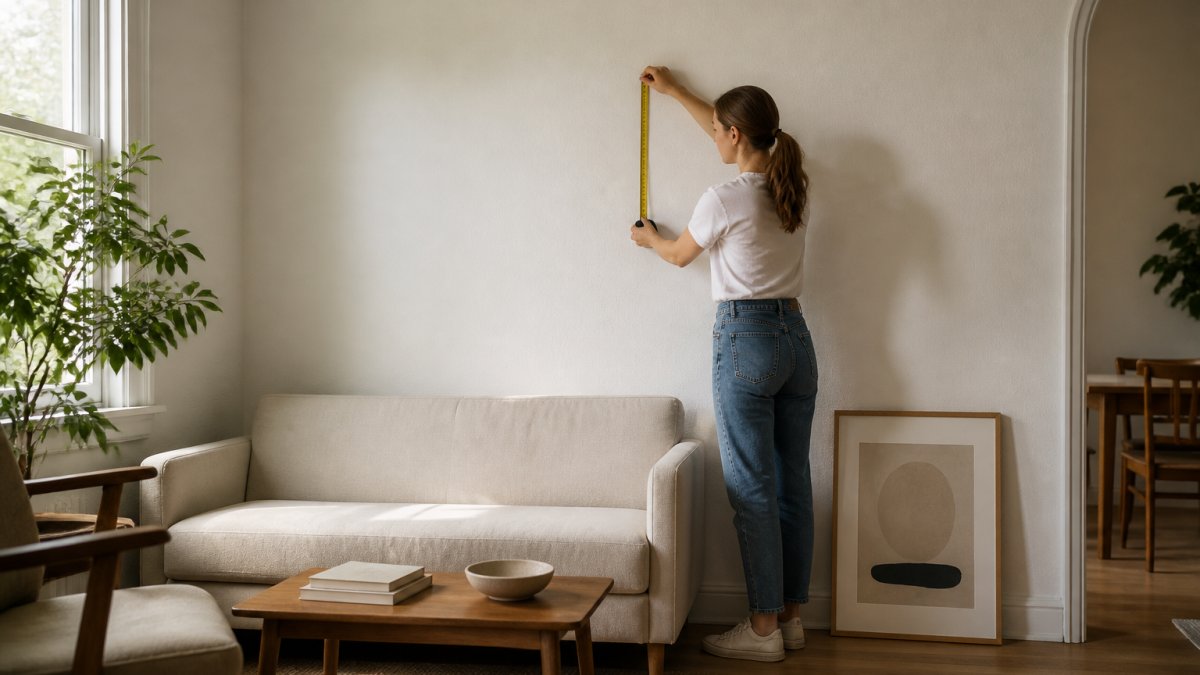
In a small room, that standard matters even more. Low-hung art drags the ceiling down. High-hung art leaves an awkward gap above the furniture.
When hanging above furniture, use a second check. The bottom of the frame should sit 15 to 25 centimetres above the furniture top.
For rooms with low ceilings, drop the centre slightly, to around 140 centimetres. For tall ceilings, raise it a little.
If you want the full step-by-step process, including hardware and measuring, see our guide on how to hang gallery walls properly.
Choosing Art to Make a Room Look Bigger
Art can stretch a room's proportions when you use it deliberately. Choosing art to make a room look bigger comes down to direction, scale, and negative space.
Vertical pieces draw the eye upward, making low ceilings feel taller. Wide horizontal pieces push the walls outward, making narrow rooms feel broader.
Neutral Shapes Minimalist Wall Art →
Three practical moves:
- Use one large piece instead of several small ones to reduce visual clutter
- Choose art with open, uncluttered compositions and generous negative space
- Keep the colour palette light and close to your wall colour
Framing matters too. A thin frame in a light finish recedes, letting the art breathe. A heavy dark frame adds weight, which can close a room in.
For more ideas on opening up a compact apartment, our post on minimalist decor ideas for small apartments covers the wider styling picture.
Matching Frames and Colours to a Compact Room
Frames and colours should support the room, not fight it.
Start with your existing palette. Pull two or three colours from your furniture, textiles, or flooring, then look for art that echoes them.
Frame finishes follow the same logic:
- Light wood warms a cool room and blends with pale walls. It recedes visually, which helps a small room feel larger.
- Black adds definition and suits modern, high-contrast interiors. Use it sparingly on narrow walls, where a dark frame can visually close in the space.
- Natural or oak tones sit quietly in Scandinavian and minimalist rooms and pair well with white or off-white walls.
Watch out: mixing too many frame finishes in one small room creates visual noise. Pick one finish and repeat it.
Frame width matters more than most guides admit. A thin frame, roughly 1 to 2 centimetres, lets the art breathe and suits small works.
Matting is another lever.
Colour temperature is worth a thought too.
If you want help pulling the palette together, our calm guide on matching art to furniture colours breaks it down room by room.
Renter-Friendly Hanging That Spares the Walls
Renters face a real constraint: every hole is a negotiation with the deposit. The good news is that you can hang art without wrecking the walls, provided you match the method to the frame weight and the wall surface.
Damage-minimising options worth knowing:
- Adhesive strips hold light frames well and remove cleanly when applied to smooth, painted surfaces. Most brands publish a weight rating per strip; a common pattern is to use two strips per pound of frame weight, but always check the pack. They work best on flat, glossy paint and fail on textured wallpaper, brick, or freshly painted walls that have not fully cured.
- Picture rails or leaning arrangements avoid wall holes entirely. A picture rail is a narrow moulding fixed near the ceiling; you hang frames from it with cords or hooks, so the only holes are for the rail itself. Leaning larger frames against the wall on a sideboard or shelf looks intentional, costs nothing, and moves with you.
- Small nail holes are easy to fill with a dab of filler and touch-up paint. Use a single nail rated for the frame weight, and place it so the frame's hanging wire sits at a shallow angle. Two nails in a V-shape stop the frame from tilting.
- Freestanding shelves let you lean frames and swap them whenever you like. A narrow picture ledge above a desk or sofa holds several small works without a single wall hole.
Weight matters. Adhesive strips have limits, so check the pack rating against your frame weight before you commit. Heavier pieces belong on a nail or a proper hook.
Surface prep is the difference between a clean removal and a peeled patch. Wipe the wall with a damp cloth and let it dry fully before applying adhesive strips.
One insider tip: lean larger frames against the wall on a sideboard or shelf. It looks intentional, costs nothing, and moves with you. For a rental-friendly gallery wall, combine a picture ledge with two or three leaned frames and one adhesive-hung lightweight print to vary the heights without adding holes.
Pick Your First Piece From the LagomDesigns Collection
Start with one piece you love, sized to your wall measurements. That is the whole strategy. Get the first piece right and everything after it gets easier.
At LagomDesigns, our framed prints are made to order on museum-quality matte paper sourced from Japan. Each arrives professionally framed and ready to hang, in four sizes and three frame finishes.
Three pieces from the collection are a good place to start:
- Neutral Shapes Minimalist Wall Art brings soft geometric calm to living rooms, bedrooms, and home offices, with clean shapes that never overwhelm a compact wall
- Calming Hues Minimalist Modern Wall Art uses a gentle, subtle palette for rooms where you want stillness above all else
- Minimal Shapes Wall Art Modern Decor adds structured, balanced geometry to a desk wall or studio corner
Because each piece is made to order once your order is placed, it is produced for you specifically. For a first buy, we would start with Neutral Shapes Minimalist Wall Art and build from there.

Frequently Asked Questions
What size art works best in a small room?
Aim for a piece that covers roughly two-thirds the width of the furniture below it, or about 50 to 75 percent of a narrow wall. In a compact room that usually means one medium-to-large framed print rather than several tiny ones. Small pieces scattered across a wall create visual clutter, while a single piece at the right scale gives the eye somewhere calm to land and makes the wall feel intentional rather than busy.
Can large artwork work in a small space?
Yes, and it often works better than a cluster of small frames. One oversized piece reads as a single visual element, so the room feels composed instead of crowded. Keep the subject simple and the colours close to your wall tone so the artwork adds depth without dominating. The limit is the wall itself: leave at least 15 to 20 centimetres of clear wall around the frame so the piece has room to breathe.
How high should you hang art in a small room?
Centre the artwork at eye level, which is roughly 145 to 150 centimetres from the floor for most adults. If the piece hangs above furniture, keep the bottom edge 15 to 25 centimetres above the sofa back or console top. In a small room, hanging slightly lower than you think keeps the art connected to the furniture and stops it floating near the ceiling, which makes low ceilings feel even lower.
How do you make a small room look bigger with art?
Choose pieces with light backgrounds, soft tones and plenty of negative space, and hang them on the wall furthest from the door so the eye travels across the room. A vertical print draws the eye upward and adds perceived height, while a wide landscape format stretches a narrow wall. Keep frames slim and colours close to the wall so the artwork reads as part of the room rather than an object sitting in front of it.
Your small space does not need much art. It needs the right art, measured, sized, and placed with intention. LagomDesigns makes that easier with framed minimalist prints in four sizes and three finishes, made to order on museum-quality matte paper and ready to hang the day they arrive. Search our store and find the piece that fits your wall, not the other way around.


