


Last Updated: October 26, 2026
Quick Summary
Minimalist home office decor means furnishing and styling a workspace with only essential, visually quiet elements so the room supports focus instead of competing for attention. It combines a neutral palette, simple furniture, concealed storage, and restrained wall art, and it works best when you limit the room to three tones.
- Measure 75-90 cm behind the desk so your chair can roll back and you can stand up.
- A closet at least 120 cm wide can convert into a full office that disappears behind a closed door.
- Hang art so its centre sits at roughly eye level when you are seated.
- Route cables with clips and a tray, and label chargers to keep the desk visually calm.
- Keep frequently used items within roughly 40-50 cm so you are not twisting or stretching.
Table of Contents
- Why Minimalist Home Office Decor Changes How You Work
- Small Minimalist Home Office Ideas for Tight Floor Plans
- Minimalist Office Color Schemes That Keep the Room Calm
- Home Office Wall Art Ideas That Add Focus, Not Noise
- Minimalist Home Office Organization: Concealed Storage and Cable Control
- Lighting, Plants and Ergonomics: The Details That Make It Cozy
- Budget Tiers and Sourcing: Building the Look Without Overspending
- Shop the LagomDesigns Framed Prints for Your Workspace
- Frequently Asked Questions
Why Minimalist Home Office Decor Changes How You Work
A calm desk does more for your focus than another productivity app. That is the core idea behind minimalist home office decor: strip the visual noise, and your brain has less to filter out.
The goal is not an empty room. It is a room where everything visible earns its place.
What most guides get wrong is treating minimalism as a shopping list. It is really a set of editing decisions. Here are the seven that matter most.
Small Minimalist Home Office Ideas for Tight Floor Plans
The best small minimalist home office ideas start with the footprint, not the furniture. Measure your available floor space first, then choose a layout that keeps the work surface clear and the walking path open. Most practitioners find that the single biggest mistake in a small office is buying the desk before measuring the chair's travel, you need roughly 75-90 cm behind the desk for a chair to roll back and for you to stand up without twisting.
Here are four measured layouts that work in real apartments, from a bedroom corner to a full closet conversion.
Bedroom Corner Office (approx. 1.5 m × 1.5 m)
A corner desk of 100-120 cm wide and 50-60 cm deep fits a laptop, a task lamp, and a small plant without crowding the bed. Place the desk on the wall perpendicular to the window so daylight falls across the work surface from the side rather than creating screen glare. Keep the chair's back to the room's open floor, not the wall, this preserves the 75-90 cm roll-back zone.
Closet Conversion (approx. 1.2 m wide × 0.6 m deep)
A standard reach-in closet is often 60 cm deep, which is exactly desk depth. Remove the door (or use a bi-fold that folds flat), add a shelf at 72-75 cm desk height, and mount a slim task light under the shelf above. This layout works best when the closet is at least 120 cm wide so you can sit centered with 20-30 cm of elbow room on each side.
Wall-Desk Layout (approx. 2.5 m² room)
For a room under about 2.5 square metres, a floating wall-mounted desk is usually the smartest move. It frees the floor entirely and makes the room feel larger. Choose a desk 100-140 cm wide and 45-50 cm deep, shallower than a standard 60 cm desk because you are not storing a tower PC underneath. Mount it at 72-75 cm from the floor for a standard chair, or 90-95 cm if you use a standing desk converter. A floating desk with no legs keeps the floor visible, which reads as more spacious.
Shared Room or Dual-Use Space
When the office shares a room with a guest bed or living area, define the workspace with a rug or a change in wall color rather than a partition. A desk 120 cm wide against the longest wall, with a single chair and a closed storage cabinet on the opposite wall, keeps the office zone visually separate. Measure the walking path between desk and cabinet: 60-80 cm is comfortable for one person; 90 cm if the room is also a thoroughfare.
If you want more calm layouts for compact rooms, our guide to minimalist decor ideas for small apartments pairs well with this section.
Minimalist Office Color Schemes That Keep the Room Calm
A neutral color palette is the backbone of a calm workspace.
Start with the largest surfaces: walls, desk, and floor. Keep two of the three in the same family. A white wall with a light oak desk and a gray chair already looks intentional.
Minimalist office color schemes work best when you limit the room to three tones: a dominant neutral, a secondary wood or stone tone, and one accent.
Where to Place Black Accents and Natural Wood
Black accents give a neutral room structure. A thin black frame, a black desk lamp, or black drawer pulls add definition without adding clutter.
Natural wood warms the palette and stops a white room feeling clinical.
If matching art to your wood tones is the sticking point, our guide on matching art to furniture colors walks through it step by step.
Home Office Wall Art Ideas That Add Focus, Not Noise
The best home office wall art ideas share one trait: low visual weight. A single piece with open space and restrained pattern does more for focus than a busy gallery wall.
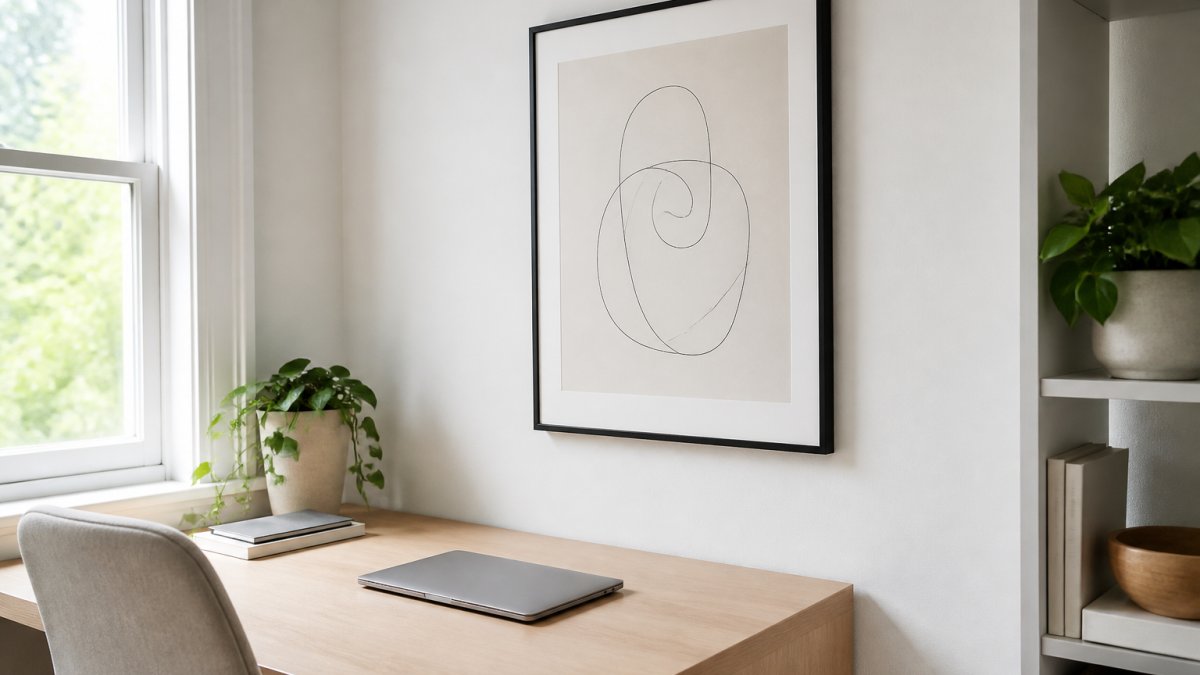
Choose art that matches the room's restraint. A piece like our Space for Thinking print is built around open visual space, which suits a desk you stare at for hours.

Hanging Height, Scale and Gallery Wall Rules
Hang art so its centre sits at roughly eye level when you are seated, which is usually lower than hallway height.
For a gallery wall, keep the gaps between frames consistent, usually 5 to 8 cm. If you are working with an awkward wall, our guide on arranging a gallery wall in a small apartment covers the layout rules in detail.
Space for Thinking Minimalist Wall Art →
Best for: a single focal piece above the desk. Skip if: your wall is already busy with shelving.
Minimalist Home Office Organization: Concealed Storage and Cable Control
Minimalist home office organization comes down to one rule: if you can see it, it has to earn its place.
Cable control is the detail most setups miss. A tidy desk with a nest of cables underneath still looks messy.
- Every supply has a closed home
- Cables are clipped or in a tray
- Only current-project items sit on the desk
Open shelving can work, but treat it as display, not storage. A few intentional objects read as calm; a shelf of miscellaneous clutter does not.
Lighting, Plants and Ergonomics: The Details That Make It Cozy
A cozy workspace needs three things working together: good light, a little greenery, and a setup that does not hurt your body. Most minimalist office guides stop at "add a plant and a lamp." The details below are the ones that actually change how the room feels and how your body feels after a long session.
Lighting: Layer Natural, Task, and Ambient
Natural light first. Position the desk so daylight falls across it from the side, perpendicular to the window, rather than from behind the screen (which causes glare) or directly in front (which washes out the display).
Add a task lamp for evenings and overcast days. An adjustable-arm LED lamp with a warm-to-cool range (roughly 2700K-5000K) lets you shift from relaxed evening light to focused daytime light.
Plants: Low-Maintenance Choices That Soften the Room
Low-maintenance plants soften a minimalist room without adding clutter. A small trailing plant on a shelf or a single potted plant on the desk is enough. Choose varieties that tolerate low light and irregular watering, pothos, snake plant, and ZZ plant are the usual workhorses for a home office because they handle indirect light and missed waterings. Keep the pot simple and consistent with the room's palette: a matte ceramic or terracotta pot in a neutral tone reads calmer than a glossy or brightly colored one.
Ergonomics: Monitor Height, Chair Fit, and Reach
Ergonomics matter as much as aesthetics. Set the top of your screen at eye level, for most people that means the top of the monitor sits roughly 5-10 cm below eye height when seated, so you look slightly down at the screen rather than up or straight ahead.
Chair fit: keep your elbows near 90 degrees, feet flat on the floor (or on a footrest if the chair does not adjust low enough), and the seat pan short enough that you can slide two fingers behind your knee. Lumbar support should sit in the curve of your lower back, not at the base of your spine.
Reach: keep frequently used items, mouse, phone, notebook, within a forearm's reach (roughly 40-50 cm) so you are not twisting or stretching.
Accessible circulation matters too: leave at least 60-80 cm of clear floor between the desk and the nearest wall or furniture so you can move in and out without sidestepping. If the office is shared or used by someone with mobility needs, widen that to 90 cm.
Budget Tiers and Sourcing: Building the Look Without Overspending
You can build a calm workspace at almost any budget if you prioritize correctly. Spend on the items you touch daily, and save on the decorative layer.
| Tier | Focus | What to Prioritize |
|---|---|---|
| Starter | Desk and chair | Sturdy secondhand desk, supportive chair |
| Mid | Storage and light | Closed storage, task lamp, cable tray |
| Complete | Art and finishing | One framed print, plant, small tray |
Our framed prints sit in the affordable end of the art market while still using made-to-order production and premium materials. If you are sourcing art on a budget, our roundup of affordable framed art for new homes is a good next read.
Shop the LagomDesigns Framed Prints for Your Workspace
The fastest way to finish a minimalist home office is one well-chosen piece of art. Our collection is designed to work individually or as a gallery wall, in four sizes and three frame finishes, so it fits the wall you actually have.
Our Space for Thinking framed print is the natural pick for a desk setup. Its clean abstract composition creates open visual space, which is exactly what a focus-driven room needs.
Frequently Asked Questions
What should be in a minimalist home office?
A desk with a clear work surface, one supportive ergonomic chair, a task lamp, and concealed storage for supplies and cables. Add one or two pieces of framed wall art, a low-maintenance plant, and nothing else that does not earn its place. The test is simple: if an object does not help you work or make the room feel calmer, it belongs in a drawer or another room. Keep the desk surface to a laptop, a notebook and a mug.
How can I add personality to a minimalist workspace without creating clutter?
Put personality on the wall rather than on the desk. A single framed print such as the Space for Thinking or Japandi Colour Pop piece from LagomDesigns lets you express taste without using up work surface. Choose one accent color you love and repeat it twice at most, for example in the artwork and a plant pot. Rotate prints seasonally instead of collecting objects, and keep personal items to one small tray so the room stays calm.
What colors work best in a minimalist office?
White, beige, warm gray and soft off-white walls give the calmest base, with natural wood tones adding warmth. A monochromatic scheme, where walls, desk and shelving sit within a few shades of each other, makes small rooms feel larger. Use black accents sparingly on frames, lamp arms or chair legs for definition. One restrained color, such as a muted blue in wall art, adds interest without breaking the neutral palette.
What kind of wall art works well in a minimalist home office?
Choose framed prints with clean lines, geometric shapes or soft abstract compositions and a limited palette. A single large piece above the desk often works better than a crowded cluster, and it should sit at eye level when you are seated. LagomDesigns frames arrive ready to hang with hardware included, and the made-to-order matte prints come in four sizes and three finishes, so you can match the scale to your wall before you commit.
Your workspace should help you think, not distract you. LagomDesigns makes framed minimalist prints that bring stillness to a room without competing for attention, using made-to-order production, museum-quality matte paper, and frames built to last. Get started with LagomDesigns and give your home office a calmer, more focused wall.


